There is a narrow window each year when a Texas school district can do serious work on a roof, and it is roughly ten weeks long. Everything that happens in that window is decided now, in the fall — not in April, and certainly not in May.
If your district has flat roofs carrying gravel ballast, and those roofs are on the list for recover, replacement or coating in the next eighteen months, the gravel has to come off first. Districts that discover this in the spring end up either paying a premium for a rushed mobilization or pushing the whole roofing project to the following summer.
Built-up roofing was the default for institutional flat roofs for decades, and a great deal of Texas school construction happened squarely inside that era. A built-up roof is layers of bitumen and reinforcing felt, topped with a gravel or slag surfacing that protects the membrane from UV and physical damage. Ballasted single-ply systems, which hold the membrane down with washed river rock or concrete pavers instead of fasteners or adhesive, were common on large low-slope roofs for similar reasons.
Both systems work. Both are also, at this point, frequently at or past their service life on campuses built in the 1970s through the 1990s. And both carry somewhere between ten and twenty-five pounds of aggregate per square foot that has to be removed before anything else can happen to that roof.
For a district, that aggregate is three problems at once:
It hides the roof. You cannot meaningfully assess a membrane, find the source of a leak, or inspect flashings and drains under a gravel bed. Districts routinely commission roof condition assessments that stop short of being useful because the surface is buried.
It is heavy. Aggregate load matters for structural evaluation, and it matters enormously if the district is considering rooftop solar, new HVAC units, or any other added dead load — increasingly common as districts pursue energy projects.
It is in the way. No recovery, no coating, no TPO or PVC retrofit, and no meaningful repair happens until it is gone.
The aggregate is lifted off the roof and into a truck. The method is what separates a three-day job from a three-week one.
Manual removal means crews with shovels, wheelbarrows, and a debris chute or crane-lifted bucket. On a school campus, it is the wrong tool for reasons that have nothing to do with labor cost: it is slow, it is loud, it generates dust and traffic across parking lots and walkways, it risks membrane damage from shovels and wheel loads, and it puts a lot of people and equipment on a roof for a long time.
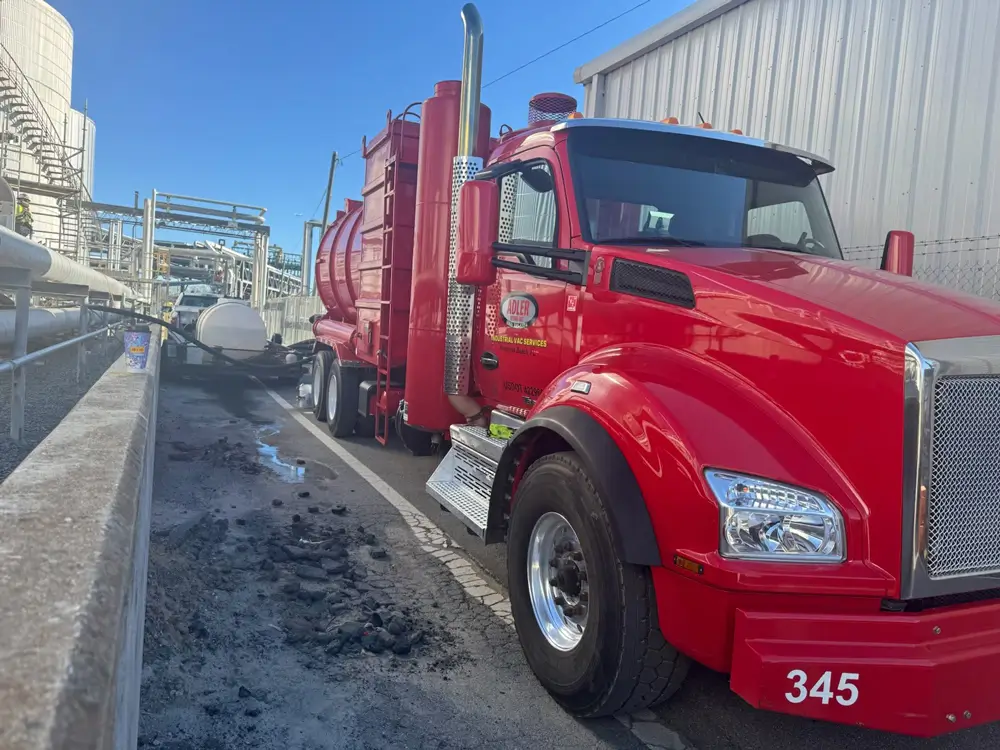
Vacuum removal uses a high-capacity vacuum truck parked at grade with a hose run up to the roof. Aggregate is drawn off the surface and into the truck’s debris tank, which then hauls it away directly. There is no staging pile, no chute, no dumpster sitting in a bus lane for two weeks, and dramatically less foot traffic on a membrane you are trying not to damage.
The practical difference on a large campus roof is measured in days rather than percentages, and days are exactly what a summer schedule does not have to spare. Roof vacuuming and BUR gravel ballast removal are worth understanding as distinct services from the roofing work itself — the crew that removes the ballast is frequently not the crew that installs the new system.
Count the actual working days. Most Texas districts release campuses somewhere from late May to early June and need them back for staff in early August. Inside that span you lose days to summer school, athletics and band camps, facility rentals, custodial deep-cleaning schedules, and — reliably — weather. A Gulf Coast district can lose a week in June to rain without anything unusual happening.
What is left is not ten weeks of roof access. It is closer to six or seven usable weeks, shared across every capital project on that campus.
Ballast removal sits at the front of that chain. If it slips, everything behind it slips, and the roofing contractor who scheduled crews around your dates is now working around someone else’s.
Whoever prices this work is going to ask for the following. Having it ready in the fall is the difference between a firm number and a padded one.
October–November. Walk the roofs. Identify which campuses have ballast and which are on the capital list. Gather the data above. Get a budgetary number so the figure in the board presentation is not a guess.
December–January. Decide the procurement path with counsel and your architect. Determine whether ballast removal rides inside the roofing package or stands alone.
January–February. Issue the solicitation. Construction procurement in a district is not a two-week process, and vendors bidding summer work are committing crews across multiple districts at once.
March. Award, with enough runway for the contractor to schedule crews, order materials, and confirm disposal.
April–May. Pre-construction coordination: site access, staging, parking, hours, keys, badging, safety plans.
June–July. Execute.
Districts that start this in February are competing for the same summer crews as districts that started in October, and they are competing from behind.