Hydro vac excavation is the preferred method for Texas contractors due to its precision, safety, and ability to handle the state’s challenging soil and utility conditions. By using pressurized water and a vacuum excavation system, it minimizes risks like utility strikes and soil instability while complying with strict state regulations. Here’s why it stands out:
Hydro vac excavation is reliable for navigating Texas’s unique challenges, from soil conditions to urban infrastructure, while meeting regulatory and environmental standards.
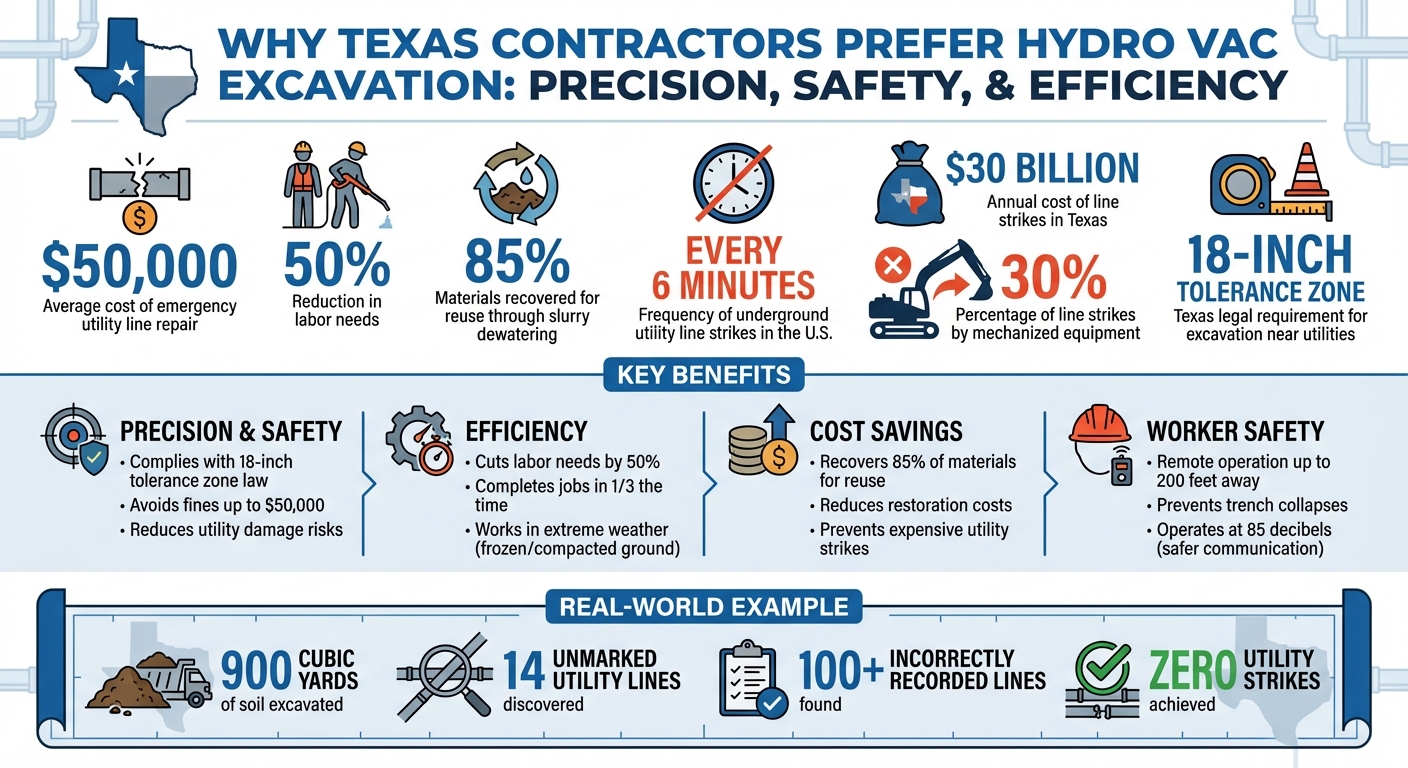
Key Benefits and Statistics of Hydro Vac Excavation in Texas
In Texas, contractors often battle clay-heavy soils that create unpredictable challenges like subsidence, unstable slopes, and erosion. A study in Nature Cities revealed a concerning issue: major Texas cities are gradually sinking, making soil stability a top priority for excavation projects.
Urban areas like Houston are particularly vulnerable, with concentrated clay deposits increasing the risks of subsidence and erosion. Traditional mechanical excavation methods – using sharp metal tools under pressure – can destabilize these dense soils, especially when they encounter frozen or extremely compacted ground. This not only slows progress but also increases the risk of accidents. Hydro and air excavation services offer safer alternatives, employing heated, pressurized water to soften and remove stubborn clay without damaging nearby structures. This approach ensures precise and controlled excavation, even in challenging soil conditions.
While soil issues are significant, the dense underground infrastructure in Texas cities presents an equally complex obstacle.
Cities like Dallas, Houston, and Fort Worth are crisscrossed by a dense network of old and new infrastructure, including gas lines, water mains, electrical cables, and fiber optic systems. This underground congestion creates a hazardous environment for traditional excavation methods. In fact, in the U.S., an underground utility line is struck approximately every six minutes, with each emergency repair averaging $50,000.
The problem is compounded by outdated and unreliable utility maps. For instance, during a 2024 project, Vecta Environmental Services worked on a 14-mile pipeline in a crowded Texas corridor. The project involved methane-supplying pipes with over 320 line crossings. Shockingly, the crew found 14 unmarked utility lines and over 100 lines incorrectly recorded on official maps. By using hydro excavation, they safely removed over 900 cubic yards of soil without a single utility strike, avoiding potentially catastrophic damage to the infrastructure serving nearby homes. This example highlights the importance of excavation methods that can navigate complex utility systems with precision and safety.
But the challenges don’t stop at soil and infrastructure – Texas weather adds another layer of difficulty.
Texas’s extreme weather conditions demand excavation methods that can perform under pressure. The state’s temperature swings and heavy rainfall patterns often disrupt traditional digging operations. For example, during winter cold snaps, frozen ground can completely halt mechanical excavation. Hydro excavation, equipped with water heaters, overcomes this by breaking through frozen or hard-packed soil where traditional equipment fails.
On the other hand, Texas’s intense heat and sudden storms create tight scheduling windows for contractors. Hydro excavation proves invaluable here, offering remote capabilities that allow operators to work up to 200 feet away from the truck. This flexibility is especially useful in confined spaces or locations inaccessible to heavy machinery, ensuring projects stay on track even when weather conditions are less than ideal.
Hydro vac excavation works with an impressive level of accuracy. Instead of relying on metal buckets that might blindly dig into the ground, this method uses pressurized water to break up soil and a vacuum system to safely remove it. This eliminates the risk of direct mechanical contact with buried utilities, reducing the chance of costly damage.
This precision is especially critical in Texas, where contractors must adhere to the state’s 18-inch tolerance zone around marked utilities. According to Texas law, vacuum excavation or hand digging is required in these sensitive areas, and hydro vac is fully compliant with these regulations. Operators can fine-tune the water pressure to suit the specific soil type, ensuring they only remove what’s necessary while keeping utility lines intact.
A great example of this precision comes from a pipeline project where teams successfully excavated 900 cubic yards of soil without hitting a single utility line – a testament to the method’s reliability.
Beyond its precision, hydro vac excavation offers a safer alternative for workers. The equipment allows operators to work remotely using extended hoses, keeping them at a safe distance from potential dangers like trench collapses, gas leaks, or electrical accidents. This is a major improvement, considering that excavation-related practices contributed to nearly one-third of the 160,000 utility damage incidents reported in 2022.
The ability to dig narrow, precise trenches also reduces the need for workers to enter large, unstable excavations. This is particularly important since a single cubic yard of soil can weigh as much as a car, making trench collapses a serious hazard. Additionally, using water instead of heavy machinery minimizes the risk of accidentally puncturing gas lines or hitting electrical conduits. Modern hydrovac units even operate at around 85 decibels, which not only improves communication on-site but also reduces hearing-related safety risks.
Hydro vac excavation doesn’t just make projects safer – it also speeds them up and saves money. By cutting labor needs by about 50% and completing jobs in as little as one-third of the time compared to traditional digging methods, this technique helps contractors stay on track, even in busy urban environments.
Avoiding utility strikes is another major cost advantage. Preventing damage means avoiding expensive repairs and delays. Plus, because hydro vac excavation is non-destructive, there’s less need for restoration work on surrounding areas like sidewalks, landscaping, or other infrastructure. On top of that, on-site slurry dewatering allows for up to 85% of materials to be recovered and reused, keeping disposal fees in check.
The method’s remote capabilities further streamline operations. Hydrovac trucks can park on streets and use hoses to access hard-to-reach areas like basements or confined spaces, eliminating the need to maneuver bulky equipment into tight spots. These features make hydro vac an ideal solution for tackling Texas’s tough soil conditions and dense utility networks.
Hydro vac excavation has become a crucial tool across various industries in Texas, thanks to its precision and ability to meet strict regulatory standards. Its adaptability allows contractors to tackle complex projects efficiently and safely.
In Texas’s oil and gas sector, hydro vac excavation is indispensable for safely exposing underground utilities. This method is especially effective in areas with dense utility networks, such as pipeline crossings in urban corridors. By avoiding line strikes and correcting mapping errors, hydro vac technology helps prevent costly and dangerous incidents.
Telecommunications and utility companies also depend on potholing to locate and assess underground infrastructure like fiber optic cables, gas lines, and water pipes. This process creates small 15-inch diameter openings, or “windows”, to verify utility conditions before horizontal directional drilling begins. In cities like Houston, Dallas, and San Antonio, where underground networks are particularly dense, this approach minimizes risks associated with traditional excavation.
Beyond its practical benefits, hydro vac excavation also supports efforts to protect the environment.
Hydro vac excavation plays a key role in safeguarding Texas’s ecosystems by containing excavated material and preventing soil runoff, which helps maintain clean job sites. The method’s use of pressurized water is gentle enough to avoid damaging tree roots, making it ideal for projects in wooded or landscaped areas.
Contractors in Texas also use slurry dewatering systems to process hydrovac waste directly on-site. These systems recover materials like aggregates, sands, silts, and water for reuse. Recovered water can be recycled to flush trucks or reintroduced into the treatment system, reducing both environmental impact and transportation needs.
Hydro vac excavation’s versatility makes it a go-to solution for municipal and civil contractors across Texas. It is widely used for sewer and water line inspections, lift station rehabilitation, and emergency utility repairs. Specialized applications include pole pulling for utility upgrades and clearing debris from sumps and catch basins.
In Dallas, where expansive clay soils present unique challenges, construction teams often use heated water during colder months to penetrate the dense ground. Civil contractors also use hydro vac technology for deep pit excavations, slot trenching, and creating piers for pipe foundations.
This adaptability ensures that hydro vac excavation continues to meet the diverse needs of Texas’s industries.
Hydro vac excavation continues to stand out as the go-to method for contractors across Texhttps://adlerhydro.com/locations/texas/as. Whether it’s navigating dense utility networks in rapidly expanding cities or tackling tough soil conditions like heavy clay or subsidence-prone areas, this approach offers unmatched accuracy and safety.
The advantages speak for themselves: it’s a non-destructive method that minimizes the risk of utility strikes, speeds up project timelines, and ensures adherence to Texas’s strict regulatory requirements. Its versatility across various soil types, combined with its ability to safeguard underground infrastructure, makes it a key tool for the state’s oil and gas industry, municipal developments, and construction projects.
Another major plus is its contribution to sustainability. Advanced slurry dewatering systems can reclaim up to 85% of excavated materials for reuse, cutting down on disposal costs while reducing environmental impact – an increasingly important factor given Texas’s booming construction activity.
Adler Hydro Vac stands out as a trusted partner for contractors, offering safe and efficient hydro vac solutions. Their expertise in industrial cleaning and vacuum services ensures projects are completed smoothly, on time, and in full compliance with state laws.
When you need precise, non-destructive digging – especially in areas packed with underground utilities – hydro vac is the way to go. It’s also a smart choice for tough soil conditions, like frozen or rocky terrain, where traditional excavation methods might fall short. This method prioritizes safety and efficiency while reducing the chances of damaging existing infrastructure.
Hydro vac excavation adheres to Texas’ 18-inch tolerance zone rule by using non-invasive vacuum techniques. This method allows safe work within the zone while reducing the risk of damaging utilities. Texas regulations specifically permit vacuum excavation for this purpose. To ensure compliance and safety, it’s also essential to contact the Texas 811 notification center at least two business days before starting any digging. This step ensures underground utilities are accurately marked, supporting safer excavation efforts.